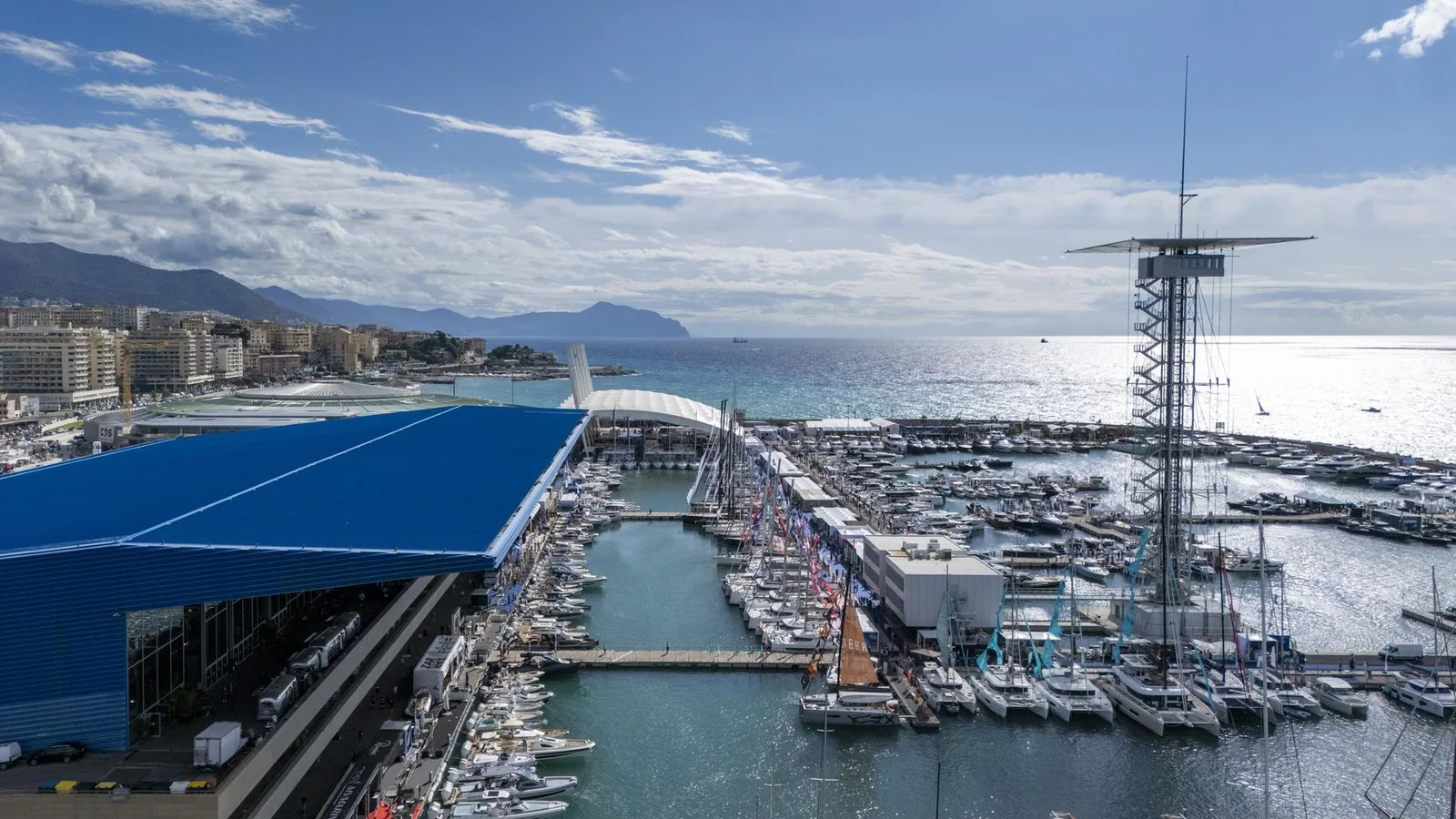
Twenty years ago Genoa was the largest boat show in Europe and one of the most important in the world. Today it opens its 66th edition with more than a thousand boats and 45 countries represented. Between those two sentences sits a story usually told as a spectacular collapse. Check the numbers and that story proves too simple: the real break came somewhere else, three years later than most people assume.
The Salone Nautico Internazionale di Genova opens today, 1 October, and runs until 6 October. The organiser, Confindustria Nautica, announces more than a thousand boats, 215 new products and representation from 45 countries across five continents. The in-water display has grown by four per cent year on year.
Those are the opening-release figures. Two others in the same material passed almost unnoticed. We will return to them at the end because they say more about direction than the attendance number alone.
The number that looks like a catastrophe — and is not
Every article about Genoa begins with the same comparison: 315,000 presences in 2008 against 124,248 visitors in 2025. A sixty per cent fall. The end of an era.
The problem is that these are not the same measurements.
At its peak, the show ran for nine days and covered two weekends. It now runs for six days with one weekend, as the local press noted in its review of last year’s edition. On top of that sits a change of unit. The organiser used to report presenze, or presences: every turnstile crossing, including exhibitors, staff and repeat admissions on multi-day passes. Under electronic ticketing it now reports visitatori, or visitors. Dividing one number by the other produces an impressive percentage, but not a reliable account of the actual change.
There is also the scope of the event. Genoa lost fisheries and diving sections that once attracted a broad public with little direct connection to the yacht market.
None of this means nothing happened. It means the scale of the fall is difficult to measure because there is no consistent data series. The low point reported by the local press came in 2013–2014, with attendance around 115,000 and 107,000. The number has since climbed to 120,864 in 2024 and 124,248 in 2025, up 2.8 per cent year on year. The growth is slow, but it continues in the same direction.
The record of roughly 350,000 in 2003 remains out of reach and nobody sensible claims otherwise. Trying to catch Düsseldorf on visitor volume alone makes little sense. Genoa has to win on something else.
What actually collapsed — and it happened in 2015, not 2012
The received version points to December 2011, when the Monti government’s “Salva-Italia” decree introduced a mooring tax on recreational craft. The levy did hit Italy’s domestic market and it became a turning point for sentiment. Yet the show had started contracting earlier with the credit crisis. Between the 2006 and 2008 editions, exhibitor numbers fell from more than 1,650 to around 1,450. Both figures came from the organiser and are difficult to reconstruct independently today.
The real break — the one that removed the top end of the market from Genoa — came in 2015 and was political within the industry rather than fiscal. A group of leading builders left the then UCINA and founded the rival Nautica Italiana, linked to Fondazione Altagamma. Ferretti Group and Azimut-Benetti were among the names that broke away. From May 2017 that community had its own event, the Versilia Yachting Rendez-vous in Viareggio. Premium exhibition budgets, meanwhile, increasingly flowed to Cannes and Monaco.
Within a few seasons Genoa had therefore lost not so much its public as its headline acts. A show once considered compulsory for every serious European yard became one where the biggest Italian names were missing — in their own country.
That chapter symbolically closed on 5 March 2025, when Azimut-Benetti rejoined Confindustria Nautica after a decade away. Its membership application was approved unanimously. It is one of the clearest pieces of evidence that the show’s recovery is not merely the organiser’s narrative.
Two hundred and forty million euros and a new shoreline
A rebuild ran in parallel, without which no recovery in standing would have been possible because the old exhibition infrastructure was simply obsolete. Waterfront di Levante, designed by Renzo Piano Building Workshop with OBR, covers 115,000 square metres, including almost 15,000 square metres of new harbour basin and 16,000 square metres of park. The City of Genoa places the total private investment at around €240 million.
The schedule stretched across years and the show operated on a building site for several editions. The rebuilt Palasport opened in July 2024 and Waterfront Mall in March 2026. This year’s edition is the first to use the intended layout, which helps explain the four per cent increase in the in-water display.
The internationalism test
The word internazionale has been in the title for decades. The question is what supports it today.
The organiser reports 45 countries represented, the same figure as in 2025. It does not publish a hard percentage of foreign exhibitors, however, and that is the number that would allow the show’s international character to be assessed without marketing shorthand.
What can be counted is this. Last year 1,245 journalists were accredited, while the foreign-buyer programme run with the Italian Trade Agency included delegations from more than 35 countries. This year the number of invited international buyers rises from 70 to 180, including buyers, importers, distributors and dealers. More than doubling the number in one season is deliberate and measurable.
For context, the Cannes Yachting Festival displayed more than 700 boats with over 680 exhibitors in September; boot Düsseldorf reports more than 214,000 visitors and around 1,500 exhibitors from almost seventy countries; and the Monaco Yacht Show closed with 118 superyachts and more than 560 exhibitors. These are three different models serving three different markets, and none is what Genoa is.
One observation remains uncomfortable for Genoa and should be stated plainly: global brokerage houses concentrate their presence and sales fleets in Monaco and Cannes. The superyacht segment, in which Italy leads the world, barely exists in Genoa in the form it takes two hundred kilometres to the west.
What the organiser says
In the official release, Confindustria Nautica president Piero Formenti describes Genoa’s strength through industry representation, market presence, industrial vision and international reach. The organiser consistently calls it an event created “by the industry for the industry”. The emphasis is not on returning to gate records from two decades ago, but on larger boats, commercial relationships, sea trials and the full supply chain.
That fairly describes Genoa’s current position. This is not an event about global capital in the Monaco sense. It is an event about the production market, technology and the supply base of Europe’s strongest yacht-building industry.
What exists nowhere else
Return to the two figures in the opening release that say the most about direction.
First, the average size of the three largest boats in each segment is up 14.1 per cent against 2025. Second, the number of multihulls on display has risen by 28 per cent. This is precisely the movement seen in Port Hercule a week ago: upward and towards catamarans. Genoa is not standing still; it is moving where the market is moving.
Then come advantages the competition does not have. Last year’s show generated 4,050 sea trials. Genoa offers access to open water on a scale that the confined Vieux Port in Cannes cannot match. TechTrade Days brings together hundreds of equipment, component and technology brands — the part of the industry largely absent from Monaco, which presents finished superyachts rather than everything used to build them. Last year’s conference programme included 132 events, among them Forum25 under European Commission patronage.
Most importantly, the show serves an industry in good health. The latest Confindustria Nautica data, published the day before the opening, puts Italian leisure-marine turnover at a record €8.72 billion in 2025, up 1.4 per cent. Exports reached €4.4 billion and direct employment 32,420, while the wider supply chain supports about 170,000 jobs. Italy also holds 52 per cent of the global superyacht order book.
The show should therefore be read through more than individual premieres. In Genoa, a buyer can quickly compare different deck, propulsion and stabilisation concepts — for example by setting Absolute’s four-boat display against the solutions offered by technical suppliers. That cross-section can be more valuable than another closed cocktail beside a single superyacht.
What follows
Genoa did not fall as far as the most frequently repeated figure suggests, because that figure compares nine days with six and presences with visitors. Something real did collapse, however, and it happened in 2015: an industry split removed the largest Italian yards from Liguria and handed the top of the market to Cannes and Monaco.
Genoa is now returning through industry, and doing so consistently. Italy’s largest group rejoined the association after a decade. The fleet is getting larger. Invited international buyers have increased from 70 to 180. Infrastructure worth around €240 million is finally working in its intended form.
Does that amount to a return to the first division? It depends on the definition. If prestige is measured by the largest superyachts and the presence of global brokerage, Genoa still trails Monaco and Cannes. If it is measured by the ability to display in one place the production market of the country holding more than half of the global superyacht order book, Genoa has a position that cannot be copied.
This is not the show it was in 2003. It is smaller, shorter and narrower. For the first time in a long while, it is also aligned with what the Italian yacht industry actually is — and that may be a stronger position than an attendance record from twenty years ago.
For a prospective buyer, any show is useful only when the model list, budget and viewing conditions are prepared before stepping onto the quay. An experienced broker such as W Yachts can help with that process, but the decision should be driven by technical data, a sea trial and the documentation of the specific yacht rather than the atmosphere of a premiere.
RynekJachtow.pl will cover the 66th Genoa International Boat Show throughout the week. We will return to the closing figures after 6 October.
Sources
- Confindustria Nautica — 66th Genoa International Boat Show · 15/09/2026
- Confindustria Nautica — pre-opening release for the 66th edition · 28/09/2026
- Confindustria Nautica — Italian leisure marine turnover reaches €8.72bn · 30/09/2026
- Confindustria Nautica — closing release for the 65th Genoa Boat Show · 24/09/2025
- ANSA — Azimut Benetti rejoins Confindustria Nautica · 05/03/2025
- la Repubblica Genova — the 2015 UCINA split · 25/03/2015
- Comune di Genova — Waterfront di Levante
- Genova Quotidiana — 2025 Genoa Boat Show review · 23/09/2025
- SoloVela — 315,000 presences reported in 2008 · 13/10/2008
- Boat International — Global Order Book 2026