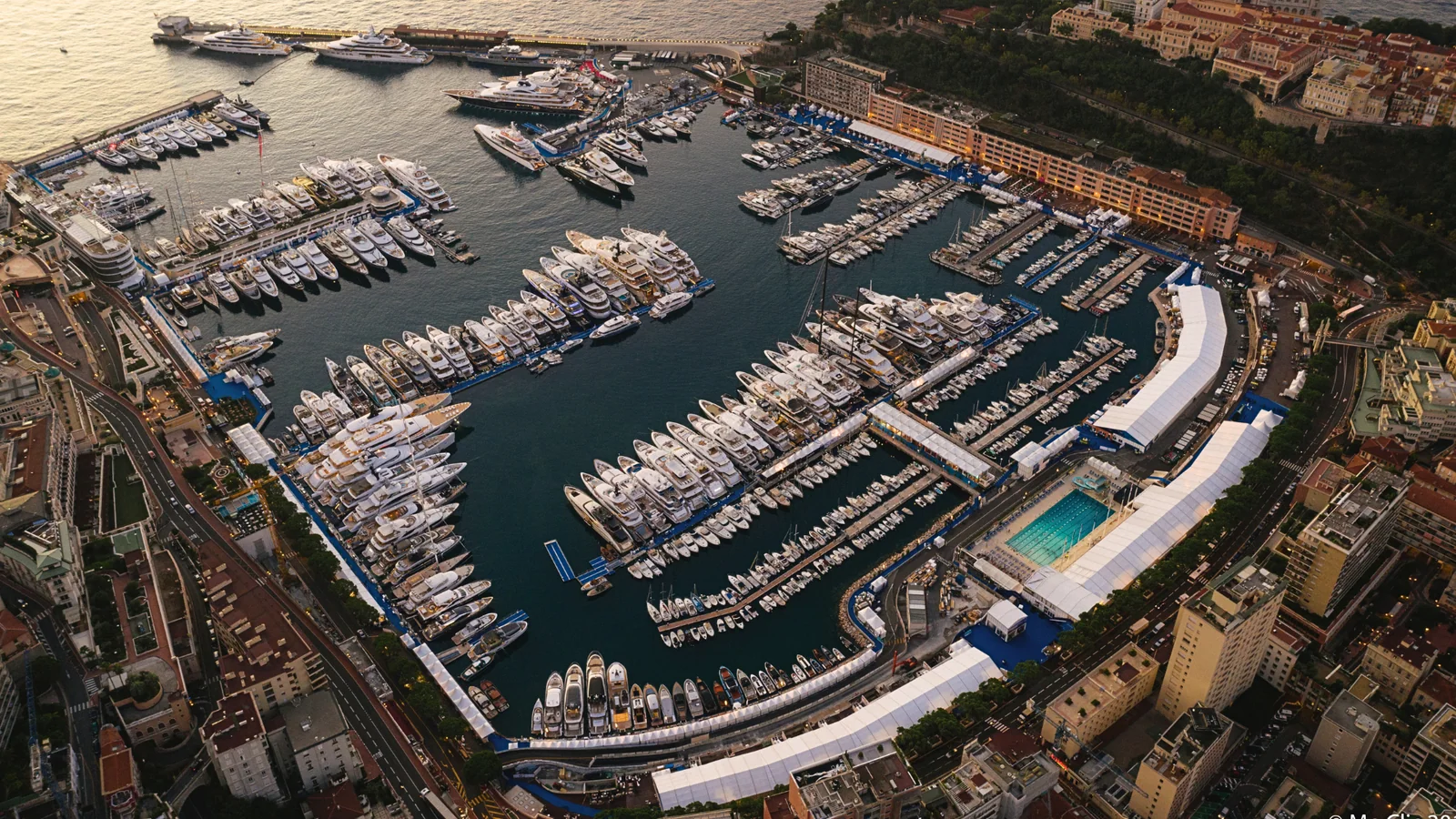
Four days in Port Hercule are over and the numbers are in. They do not add up to a single sentence. The global order book has contracted for a second consecutive year, the world’s largest series superyacht builder booked zero superyacht orders in the first half and cut its guidance — and at the same time brokers are closing deals at a pace not seen in years. This is not one market in trouble. It is two markets moving in opposite directions.
The 35th Monaco Yacht Show closed on Saturday 26 September. The organiser has not published a final visitor count or a comparison with previous years, so any verdict on whether this edition was stronger or weaker has to wait. What we do have is the fleet data, the order book and the shipyards’ own financial reporting. That is enough.
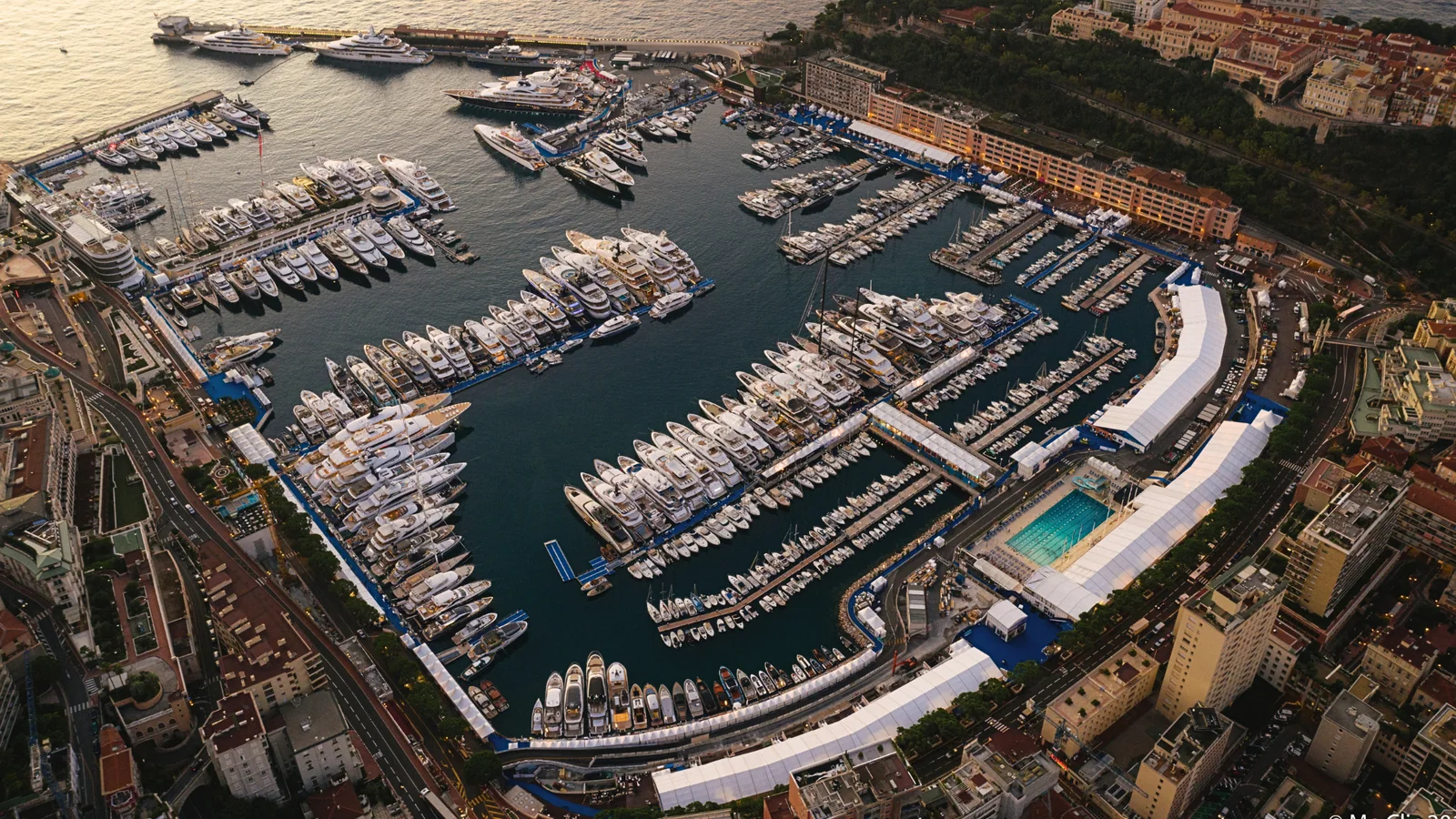
What stood in the harbour: 118 yachts and €4.5 billion
The organiser had announced around 120 superyachts, more than 560 exhibitors and 43 yachts delivered in 2026 presented as world debuts. The final quayside count, according to SuperYacht Times, came to 118 superyachts, 63 yacht builders and 60 tenders. The fleet measured 5,508 metres in combined length with an estimated value of €4.5 billion.
Independent trackers landed close but not identical: YachtBuyer Intelligence logged 117 yachts on opening day, SuperYacht24 counted 113 two days before the doors opened. The spread is ordinary — it depends on the measurement date, and the list moves until the last moment. None of the readings points to a shrinking show.
Two yachts broke 100 metres: the 111-metre Oceanco Leviathan, the largest at the show, and the 102.4-metre Lürssen Nixie, the largest debut, co-exhibited by the yard and Edmiston. Behind them came the 92.8-metre Draak, the 88-metre Angelique from Turkey’s Turquoise and the 79.8-metre Pangea from Amels.
The mechanics of the event changed too. For the first time the dockside exhibition ran across all four days rather than joining later. The organiser scrapped on-site ticketing in favour of online-only sales, added Networking Decks at Quai Albert 1er and Darse Sud, gave 15 to 17-metre tenders their own on-water showcase in the Adventure Area, and replaced the Yacht Design & Innovation Hub with a Designer Gallery. These are not cosmetic changes. They move the show from a display model towards a meetings model.
The order book: fewer hulls, more tonnage
This is where the real story sits. The Global Order Book 2026 published by Boat International records 1,093 superyachts on order or under construction — 45 fewer than a year earlier, down 3.95 per cent. It is the second consecutive year of decline.
Most commentary stops there. It should not. In the same order book, combined gross tonnage under construction rose by roughly four per cent to 602,092 GT. Average tonnage per hull jumped from 507 to 551 GT — up 8.7 per cent in a year. Average length passed 40.8 metres.
The meaning is precise: fewer boats are being built, and each one is materially bigger and more expensive. The fall in unit numbers is not evidence of weakening demand but of capital moving out of volume and into volume of a different kind. Read the order book by hull count alone and you reach the opposite conclusion to the true one.
Zero: the number that says more than the whole fleet in Port Hercule
On 31 July, less than eight weeks before the show, Ferretti Group published its first-half 2026 results. Net revenue €585.6 million, down 5.6 per cent. Net profit €37.9 million against €43.6 million a year earlier. Net backlog down 25.7 per cent to €564.9 million. Total order intake down 26.9 per cent to €341.4 million.
Inside that report sits a line that cannot be walked past. Order intake in the superyacht segment was zero euros — against €64.9 million a year earlier. Not a double-digit percentage decline. Zero, across a full half-year, at the largest series builder in the world.
The regional split adds a second layer. Middle East and Africa: €92.9 million against €130.6 million. The Americas: €73.4 million against €142.8 million, a fall of almost half — deeper than the Middle East, which the industry discusses far more often. The only region in growth was Asia-Pacific, up more than threefold to €39.9 million. The group cut its 2026 revenue guidance to €1.2–1.24 billion.
Ferretti Group CEO Stassi Anastassov summarised the results in a sentence worth keeping: “Our challenge today is therefore primarily commercial rather than financial.” The money is there; the orders are not.
The same Anastassov declared in Monaco on 23 September that Ferretti Group comes to the show “to lead, not simply to participate”. There is no contradiction to score points off — one is an investor communication, the other a marketing one. But placing the two eight weeks apart shows how this market has to be read: what is said on the quay and what is reported to the market are two different sources, and only one of them is audited.
The brokerage market is working — but only in one band
Anyone reading collapse into the above is as wrong as the reader who takes the order book at hull count. The 2026 brokerage market is in good health — just not everywhere.
Fraser reported in February 12 superyacht sales in 12 days, with a combined last asking price of around US$250 million, following more than 30 further sales across the preceding four months. Burgess counted 31 transactions in 32 weeks, at an average length of 50 metres and an average asking price of €42 million, ranging from 30-metre yachts to vessels above 90.
Burgess also analysed a hundred yachts from 30 to 100 metres, and produced the single most useful figure of the season. For every additional five metres of length, ownership costs rise by roughly 15 per cent while charter revenue rises by roughly 22 per cent. The sharpest increase in charter rates falls between 55 and 60 metres. That is the arithmetic behind the 40 to 60-metre band being the centre of gravity of this market: a yacht in that range earns faster than it costs, and still fits the smaller Mediterranean marinas and anchorages.
On opening day, per YachtBuyer Intelligence, 70 of the 117 tracked yachts were for sale, with a combined asking value of around $2.5 billion at an average of $35.2 million. SuperYacht24, counting six days earlier, put 62 yachts on the market at €2.1 billion. Those are asking prices, not transaction prices — how many change hands, and at what discount, will be known in months. No brokerage house announced a completed brokerage sale during the show, and that is not a sign of weakness: these deals need surveys, sea trials and ownership structuring, not four days.
The new-build side did produce announcements. Just before the opening, the sale of the 125-metre-plus Lürssen Project M with 2032 delivery was confirmed — an eight-year horizon that did not deter the buyer. In August, Italy’s Tureddi Yachts sold its first 52-metre Stil Novo, entering the custom segment.
Who is growing: Turkey, the Netherlands and eighteen German hulls
The country breakdown of the order book is the most interesting table of the year, and almost nobody quotes it in full.
Italy builds 568 yachts — more than half the global unit volume — for 240,560 GT at an average length of 39.3 metres. Turkey ranks third by unit count: 141 yachts, 82,383 GT, averaging 44.8 metres. This is no longer the budget alternative but the world’s third builder, and Port Hercule showed it: the 88-metre Angelique from Turquoise, the 62-metre Simena from Ares Yachts, the 52.5-metre Gray Wolf from Mengi Yay, the 55-metre Meira from Neta Marine, the 39.3-metre S7 from Tansu, the Sirena 42M premiere and the first hull from GX Superyachts.
The strongest figures in that table, though, belong to two other countries. The Netherlands builds 66 yachts totalling 107,796 GT — more tonnage than Turkey from fewer than half the hulls. Germany builds 18 yachts averaging 100 metres, for 78,651 GT. Eighteen German hulls come close to matching the tonnage of one hundred and forty-one Turkish ones. That is the division of this market that unit statistics hide: Italy and Turkey supply volume, the Netherlands and Germany supply mass.
Sustainability: an award with a number attached
The Blue Wake Awards are easy to file under show programming. This year there is less reason to: 60 projects were submitted and validated, with independent assessment by the Water Revolution Foundation across four dimensions — emissions reduction, material circularity, design innovation and protection of aquatic ecosystems. Awards went to six categories.
The special prize for a yacht went to Simena, the 62-metre hybrid sailing yacht from Turkey’s Ares Yachts, with 220 kW electric motors and energy regeneration under sail. Her environmental assessment came out 11 per cent better than the fleet average she was measured against.
This should not be turned into evidence that the market has switched. A sailing yacht is an easier case than a 50-metre displacement motor yacht, and one award is not a trend. What has changed is the method: the prize follows a verified number rather than a shipyard statement. For a buyer, that previews the point at which fuel burn and emissions get asked about during a valuation as routinely as engine hours.
Two technology notes are worth recording. The Polish entry of this edition — the Sunreef 100 Eco, first hull named Ipharra II, launched on 17 June in Gdańsk with a 770 kWh battery bank and photovoltaics built into the hulls and superstructure — showed that full-electric propulsion is entering this segment through multihulls, because they offer the panel area and battery volume a monohull of that size does not. The second is Feadship’s 115-metre Hive concept, unveiled in Monaco and the largest the yard has produced. A concept is not an order, but it shows which way a Dutch yard is steering the conversation with its clients.
What it means for a buyer
Three things, each anchored to a figure rather than an impression.
First, time. Build slots at leading yards are booked into 2028 and 2029, and the Lürssen sale with 2032 delivery shows that at the top of the market an eight-year horizon is acceptable. If it is not acceptable to you, the conversation moves to the brokerage market — and supply there is real: 70 yachts for sale in a single harbour across four days.
Second, size. The Burgess arithmetic — costs up 15 per cent, charter revenue up 22 per cent for every five metres — states plainly where the best ratio of cost to capability sits. The 40 to 60-metre band is not fashionable by accident.
Third, direction. Zero superyacht orders at Ferretti in a half-year, alongside an 8.7 per cent rise in average tonnage across the whole order book, means the money has not left the market. It has moved from series production to custom, and from smaller hulls to larger ones. For a buyer in the series segment, that is the first time in several years that the negotiating position favours the buyer rather than the yard.
Turning those figures into a specific shortlist, budget and set of purchase terms requires work on the documents of an individual yacht; an experienced broker such as W Yachts can support that process. It is also worth comparing the final data with our report from the opening days of Monaco Yacht Show.
And one thing no report states outright: this edition showed that two numbers describing the same market can lead to opposite conclusions if you only read one of them. A 3.95 per cent fall in orders and an 8.7 per cent rise in tonnage are the same market in the same year.
RynekJachtow.pl will return to the data from this edition in further analysis, including the full structure of the global order book and shipyard results for the second half of 2026 once published.
Sources
- Boat International — Global Order Book 2026
- SuperYacht Times — What's new at the 2026 Monaco Yacht Show
- SuperYacht Times — Yachts attending Monaco Yacht Show 2026
- Ferretti Group — H1 2026 financial results · 31/07/2026
- Superyacht Investor — Ferretti Group revenue falls as superyacht orders dry up
- Custom Line / Ferretti Group — Monaco Yacht Show release · 23/09/2026
- Superyacht Guide — Superyacht brokerage momentum builds ahead of autumn shows
- BusinessWire — Fraser Reports Record Start to 2026 With 12 Superyacht Sales in 12 Days · 17/02/2026
- YachtBuyer — Monaco Yacht Show 2026 fleet analysis · 23/09/2026
- SuperYacht24 — Monaco Yacht Show 2026 fleet analysis · 21/09/2026
- Monaco Yacht Show — official 2026 superyacht list
- Monaco Yacht Show — Blue Wake Awards 2026 · 23/09/2026
- SuperYacht Times — New 125m+ Lürssen superyacht Project M sold
- SuperYacht Times — Tureddi Yachts sells 52m new-build Stil Novo
- SuperYacht Times — Feadship unveils 115m Hive
- Boat International — first Sunreef 100 Eco launched · 17/06/2026