I took the invoices for a 53-foot motor yacht in the Mediterranean and compared them with the published charter price of a specific yacht in Dalmatia. The exercise produced a break-even point, two costs hidden by the weekly rate and three situations in which I would still tell a client not to buy.
Let me begin with the sentence that belongs at the top, not in the small print: I earn money by selling yachts. When a client buys, I receive a commission. Read everything that follows with that in mind and judge each number on its own merits. That is precisely why this calculation is not based on a rule copied from a boating forum. It starts with invoices I actually pay and a publicly available charter rate that can be checked.
I hear the same question in almost every first conversation: why buy a yacht if I am only going to use it for two weeks a year? Would it not be cheaper to charter?
It is a fair question. In some cases, the honest answer is yes — charter. Before reaching that answer, however, we need to put a figure on the table that is usually missing from the comparison: what does it actually cost to keep this type of yacht for a year?
€45,000 — based on invoices, not an internet percentage
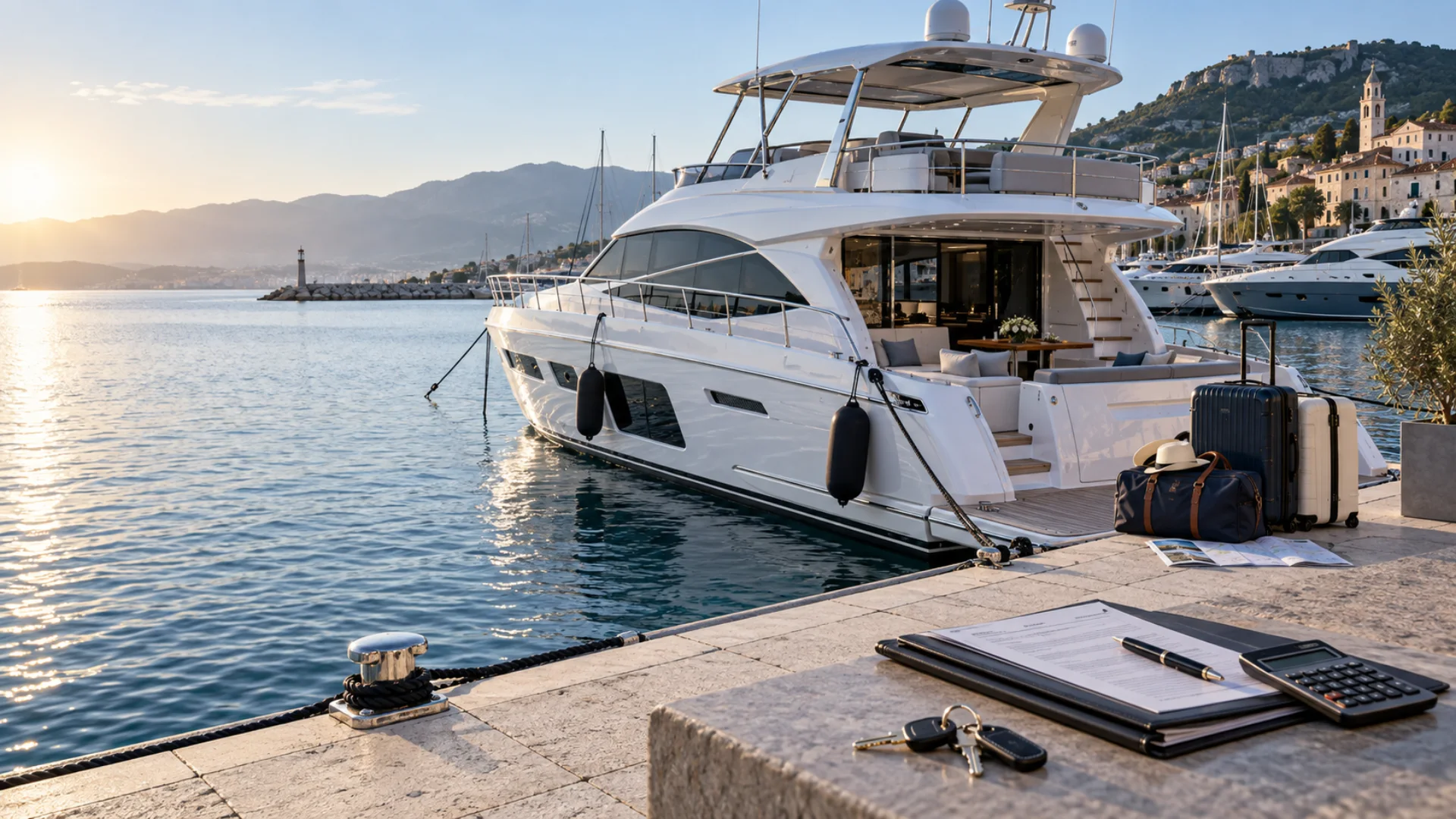
My example is deliberately specific: a 53-foot motor yacht, three to five years old, based in the Mediterranean and operated without permanent crew.
- marina berth: €18,000 per year;
- insurance: €12,000;
- servicing and antifouling: €10,000;
- minor repairs and replacement of worn components: €5,000.
Total: €45,000 per year.
Notice what is not included: fuel. That is intentional. A charter client pays for fuel just as an owner does, so it is not a cost that separates one option from the other. Charging fuel only to ownership would distort the comparison.
Now put that €45,000 beside the rule repeated on boating forums: annual running costs equal 10–12 per cent of the yacht’s value. On a yacht worth €1.5 million, that would produce €150,000–€180,000 a year — for a 53-footer without permanent crew. Such a blanket percentage does not describe the bills I pay. It sounds authoritative, but it removes the need to cost the actual yacht, marina and operating pattern.
This does not mean that every 53-foot yacht can be kept for €45,000. A different marina, a permanent captain, a major failure, financing or heavy use will change the result. This is a real case study, not a universal price list.
On the other side of the table: a real yacht, not a price range
The charter side also needs a specific yacht. I therefore use one I know: M/Y WHITE, a 2024 Azimut 53 Flybridge. She is approximately 16 metres long, has three double cabins for six guests and is based at Marina Lav in Podstrana, close to Split.
At the time I prepared the original calculation, her mid-season rate was €14,515 per week. After adding the package covering items such as linen, final cleaning and the transit log, the total was approximately €15,000 per week. Charter rates are dynamic. Anyone making the decision today must compare the live rate for the intended dates, not a number remembered from last season.
A skipper is included in that price. There is no captain in my €45,000 figure because I operate my own yacht. The charter yacht is also nearly new, whereas the ownership example concerns a three- to five-year-old boat. Both assumptions favour charter, and I have deliberately left them that way.
Divide €45,000 in annual running costs by approximately €15,000 for a week of charter and the result is three weeks. At peak-season rates, the break-even point for this class of yacht moves closer to two weeks.
The conclusion is simple, but only at this stage of the calculation: if you use a yacht for more than about three weeks per year, the cash running costs alone of ownership may be lower than chartering a comparable boat. That does not yet mean that buying is cheaper. The largest cost is still missing.
The cost that never arrives as an invoice
Depreciation has no due date and does not arrive by email. That makes it very easy to ignore.
In the model I use here, a motor yacht in this class may lose roughly 30 per cent of its value in its first five years and approximately half over a decade. That is not a guaranteed curve for every model. The result depends on the brand, market demand, service history, specification, engine hours, economic cycle and the price ultimately achieved at resale. But on an initial value of €1.5 million, a modelled 30 per cent fall is €450,000 over five years, or an average of €90,000 per year.
That is more than all the annual running costs combined.
I will say it plainly: over a five-year horizon, once depreciation is entered into the spreadsheet, the charter client will often win financially. There is no resale loss because the yacht was never theirs. Anyone comparing only marina and servicing costs with the weekly charter rate is presenting half the calculation.
There are, however, two ways to reduce the impact.
The first is obvious: do not buy at the steepest point of the curve. The heaviest loss often comes in the first years after launch. Let the first owner absorb it. A well-maintained three- to five-year-old yacht may have passed through the worst depreciation while remaining excellent both mechanically and cosmetically. That is the boat used in this comparison, not a new build ordered from the yard.
The second option is to place the yacht in charter management for part of the season.
A yacht can earn money, but there is no free money
Charter income can offset some fixed costs and depreciation. In a typical Mediterranean programme, the owner may receive around 65 per cent of revenue while the operator retains approximately 35 per cent for sales, client handling, turnaround, paperwork, cleaning and base operations. The precise split and the expenses charged to each side depend on the contract.
A strong-performing yacht in Croatia can achieve 20–24 charter weeks in a season. That is a possible result for the right model, location and price — not a promise. A conservative business plan must also show the effect of weaker occupancy, discounts, maintenance downtime and broker commissions.
A properly structured commercial operation may also allow input VAT on a yacht acquired for genuine rental activity to be deducted. This is not an automatic “25 per cent VAT refund”. The yacht must genuinely serve a registered business, the ownership and accounting structure must comply with the rules, and private use requires the correct tax treatment. This should be designed with a Croatian tax adviser and accountant before the acquisition, not repaired afterwards.
There is also a price that operators discuss less enthusiastically. If the yacht earns money in July and August, you are not aboard. You surrender the best weeks in exchange for income that softens the cost of ownership. Some owners accept the arrangement and cruise in June and September, often the more pleasant Mediterranean months. Others keep the yacht entirely private. Both choices are rational. What you cannot have is full availability and maximum charter income at the same time.
What the weekly price does not show
A simple comparison assumes that a charter yacht is kept in the condition in which you would maintain your own. That is not always the case.
An operator selling 20 weeks per season at an average of 15 engine hours per week puts approximately 300 hours a year on the boat. A private owner of a yacht this size may do around 100. Those are figures from my experience, not an industry standard. They nevertheless illustrate the scale: one intensive charter season can equal several quieter private seasons.
More important than the hour meter is the number of people using the boat. It is not handled by one attentive owner but by a succession of guests who may never return. The evidence often appears in topside scratches, cockpit upholstery, the bathing platform and the small fittings nobody treats as their own.
Even that is not necessarily the greatest charter risk. The larger one may be in the contract.
Charter agreements commonly contain a substitute-yacht clause. If the booked yacht cannot perform the charter, the operator may offer another with broadly similar characteristics and capacity. The difficulty lies in the word “similar”. The yacht selected in February may return damaged from a previous charter, leaving only what happens to be available at the base in August. The solution may comply with the contract while bearing little resemblance to the holiday planned six months earlier.
Weather works in a similar way. A refund or change of dates usually applies when conditions make it unsafe to leave port, not simply when the forecast is poor. Rain is not normally a reason to cancel, and withdrawing shortly before the charter may mean losing the full payment.
Before signing, calculate more than the advertised weekly rate. A realistic comparison must include fuel burn, usable range, generator demand and an appropriate reserve, as well as APA where applicable, berthing and gratuities. Only then are you comparing the total cost of the holiday with the total cost of ownership rather than two numbers describing different things.
An owner checks the forecast on Thursday, sees an unpleasant week and postpones the trip. No permission is required and no prepaid charter is lost. That is one of the practical differences between access to a yacht and ownership of one.
Eleven outings instead of two weeks
The next point is supported by neither an invoice nor an academic study. It is an observation from more than 20 years of working with owners — and the reason I no longer accept “I will only use it for two weeks a year” as a settled fact.
Almost every client says the same thing: I have no time; I will use the yacht for two or three weeks at most. Then they buy, and a year later they have been aboard eleven times. Not eleven weeks — eleven separate outings: a Friday afternoon, a long weekend in May, dinner aboard without leaving the berth, a day on the water with a client, a week in June and another in September.
Their calendar did not become less demanding. The decision changed.
With charter, the question is: can I block a full week six months from now and pay for it today? With ownership: am I free on Saturday? It is much easier to answer “yes” to the second question.
I see another pattern. Over time, owners begin organising work so that the yacht has a place in the diary. It is already in the marina and already paid for, so an unused weekend starts to feel like money left on the table. That is a broker’s observation, not an economic law. It does explain why the three-week threshold is easier to cross in practice than many clients expect before buying.
“We will buy it between three of us” — the most expensive idea in the conversation
Someone always proposes the obvious solution: buy the yacht with two friends, split every cost three ways and use one third of the season each. On paper, the numbers look three times better.
But two very different models are being confused. A professional fractional-ownership programme, with an operator, a precise agreement and a booking system, can work very well because a neutral party runs it. Three families coordinating through a group chat are a different undertaking. There is no operator, no procedure and nobody to break a deadlock. Friendship is expected to do the job of a management company.
The calendar is the first problem. Summer can be divided into three, but the first long weekend in May and the best week in August cannot. Everyone wants the yacht at the same time.
Then come the details that quietly damage relationships. You arrive for your week and the tanks are empty, so the holiday begins at the fuel berth. The previous co-owner did not clean up, so your first job is the cockpit. A charter operator has staff, procedures and a security deposit. In informal co-ownership, it is difficult to invoice a friend for leaving a mess.
Then there is money. The marina invoice arrives in January, when nobody has been aboard since September and one co-owner has had a poor year. Someone else covers their share — and usually not for the last time.
When a friendly agreement reaches court
The applicable rules depend on factors including the yacht’s flag, ownership structure and the governing law of the agreement. The example below uses Polish law and is not individual legal advice.
Under Article 210 of the Polish Civil Code, each co-owner can demand termination of the co-ownership. The right can be contractually excluded for no more than five years, although it can be extended for further five-year periods before expiry. One co-owner does not require the consent of the others to go to court.
A yacht cannot realistically be divided physically. The court may therefore award it to one person subject to payments to the others, or order a sale. Sale is not automatic, but it becomes a real possibility when nobody is able or willing to take the whole asset.
If the yacht is sold through enforcement proceedings as movable property, Article 867 §2 of the Polish Code of Civil Procedure sets the opening price at three quarters of the appraised value at the first auction and one half at the second. Valuation, proceedings and sale costs are added to the loss.
In practice, one determined co-owner in a serious dispute can start a process that ends with a sale well below the price a broker might achieve in an orderly transaction.
My rule is simple: if buying the larger yacht alone would cause financial strain, buy a smaller yacht and own all of it. Full control of a smaller boat is worth more to me than one third of a larger yacht that I cannot control.
Who I genuinely advise not to buy
I will now argue against my own commission. There are three groups of clients whom I deliberately direct towards charter. I would rather say it before the transaction than let them discover it after two seasons.
The first group consists of people who genuinely cannot get away from work regularly — not those who simply say so, but those whose business has required their physical presence for years.
The second group wants a different cruising ground every year: Croatia now, the Balearics next season and the Caribbean after that. An owned yacht has a home port, and moving it costs time and real money.
The third group is the most important: people without experience. If this would be your first yacht over 12 metres, charter for a season and try two or three different boats in the area where you expect to cruise.
I am not saying this to be polite. A season of charter costs a fraction of a mistaken purchase. I would rather sell you the right yacht next year than the wrong yacht this month.
What this means for you
In this case study, annual cash running costs are €45,000 and the break-even point against charter sits around the third week. Buying at three to five years old may allow you to avoid the harshest phase of depreciation. The next choice is yours: place the yacht in charter for part of the season, or accept depreciation as the price of complete availability.
Use the yacht for more than three weeks and running costs alone may fall below the price of a comparable charter. Once depreciation and the cost of capital are included, the answer depends on the boat’s age when purchased, the ownership period, the eventual resale price and any charter income. A proper calculation uses the figures for the specific yacht, not averages copied from the internet.
I wrote at the beginning that I earn money when a client buys. That remains true. I have also given you numbers that can be checked and three situations in which I would recommend charter instead. Judge the argument on that basis.
One final question is worth more than the entire spreadsheet:
How many days did you actually spend on the water last year? Not how many you planned — how many you really used.
That single number answers most of the question: charter or own?
If you want to run the calculation for a specific model, current yachts, charter opportunities and the brokerage team are available through W Yachts.
Tomasz Wrzesiński is a yacht broker. This article is for information only. Tax and legal matters must be checked for the particular flag, ownership structure, country of registration and intended use of the yacht.