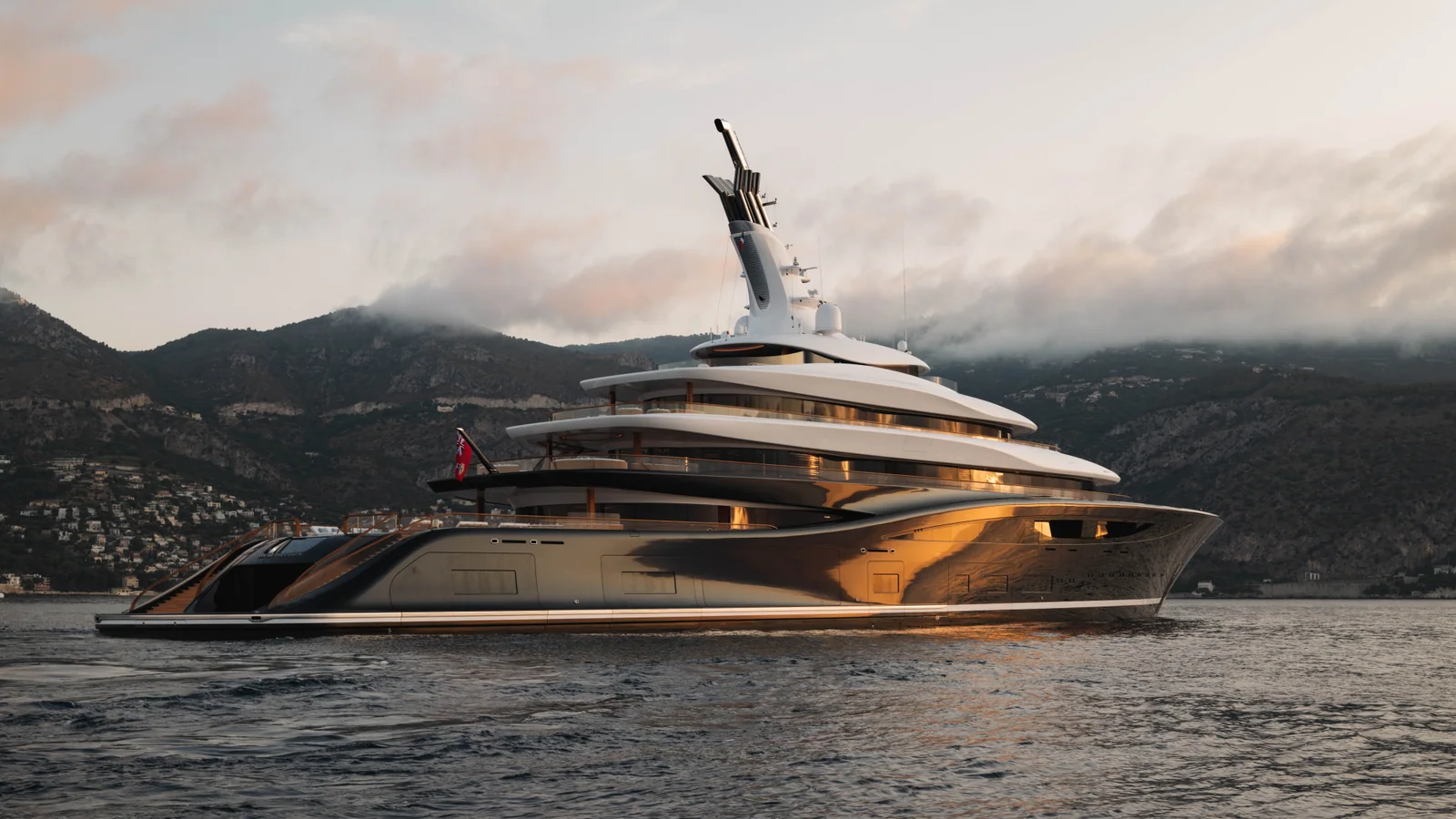
The world’s most expensive hydrogen yacht is called Breakthrough. The name is perfect, because this 118.8-metre Feadship really did cross a line that no other superyacht had crossed: it stores liquid hydrogen on board and uses it in fuel cells. It floats, it has bunkered hydrogen and it has changed hands.
That makes it the most useful case study in the entire debate about hydrogen yachting. It also exposes a gap between what the technology can demonstrate and what an owner can rely on.
I am not arguing against cleaner yachting. I am arguing against pricing an experiment as if it were a mature product. Those are very different propositions, especially when the asset costs hundreds of millions of euros and its future buyer will scrutinise every unconventional system.
The space penalty cannot be negotiated away
The decisive figure is not the number of fuel cells. It is energy per litre. Diesel stores roughly four times as much energy by volume as liquid hydrogen before the tank is considered. A marine hydrogen tank then needs double walls, vacuum insulation, safety zones and a shape capable of handling extreme temperature and pressure changes. Diesel can occupy awkward spaces low in the hull; a cryogenic cylinder dictates the architecture around it.
Feadship has been unusually candid about the consequence. Storing hydrogen requires eight to ten times more space than the diesel equivalent. Breakthrough carries approximately four tonnes of hydrogen in a 92-cubic-metre tank system. The yacht was lengthened by four metres to accommodate the installation.
On a yacht of this size, four metres can represent a large guest suite or a substantial part of a beach club. This is the hidden currency of the transaction. The owner does not merely pay for the equipment. The owner gives up some of the most expensive habitable volume ever built.
A fuel that does not wait for the owner
Liquid hydrogen must remain at about minus 253 degrees Celsius. Heat entering the tank causes part of the fuel to evaporate. The gas must be consumed, managed or vented safely. Feadship has not published a daily boil-off figure for Breakthrough, so inventing one would be irresponsible. The underlying operational issue, however, is unavoidable: a hydrogen yacht cannot be treated like a diesel yacht left in a marina with its tanks untouched for weeks.
This changes how the asset is planned, crewed and insured. The technology demands a usage profile. A wealthy owner may accept that limitation, but it must appear in the purchasing decision before the contract is signed, not after the first season.
Infrastructure is an operation, not yet a network
The first documented liquid-hydrogen bunkering of Breakthrough in Amsterdam required a truck-to-ship operation and a new safety procedure. A later operation in Antibes also relied on a tanker rather than an established marina pump. These are impressive achievements, but they are evidence of bespoke logistics, not a Mediterranean refuelling network.
The legal framework is still moving as well. The IMO approved interim hydrogen-fuel guidance in 2026, while Breakthrough was developed through an alternative-design approval with its classification society and flag administration. The yacht is validly classed, but a future buyer will still ask how its individual solution compares with rules that did not exist when the system was conceived. In yacht brokerage, every question that cannot be answered with a recognised market precedent eventually becomes a price discussion.
The resale market has no comparable evidence
New technology creates a double risk. The first owner pays the development premium; the second owner decides whether that premium has lasting value. There is no deep fleet of liquid-hydrogen superyachts, no meaningful series of secondary-market transactions and no public loss history from which insurers can build a conventional tariff.
That does not make Breakthrough a bad yacht. It makes it a singular asset whose valuation depends on a very small group of future buyers willing to inherit the same operational complexity. Scarcity can produce a premium in collectable assets. In technical assets, it can also produce a discount when parts, specialist crew, fuel and regulatory certainty remain scarce.
What works for owners today
The less glamorous alternatives are currently more useful. HVO can reduce lifecycle carbon emissions without replacing proven diesel machinery, subject to fuel provenance and engine approval. Diesel-electric hybrid systems with meaningful battery capacity can eliminate generator noise at anchor and reduce inefficient engine hours. Those solutions do not offer a zero-emission headline, but they solve problems owners can feel immediately: vibration, noise, local emissions and fuel burn.
Hydrogen may become part of the answer. Breakthrough has already advanced the engineering conversation enormously. But an owner buying today should ask seven written questions: usable hydrogen range, lost internal volume, named bunkering locations, daily boil-off, fuel-cell life, classification basis and a documented resale precedent.
If the last answer is “none”, the buyer is not purchasing an established propulsion option. The buyer is financing a position in an experiment. That position may be worth taking — but it should be priced as an experiment, without the green premium that marketing departments would like to attach to it.
For a buyer comparing conventional, hybrid and alternative-propulsion yachts, W Yachts can build the technical and financial due-diligence brief before the offer is made. Our next practical step is to compare this risk with the far more familiar question of real fuel consumption and range.