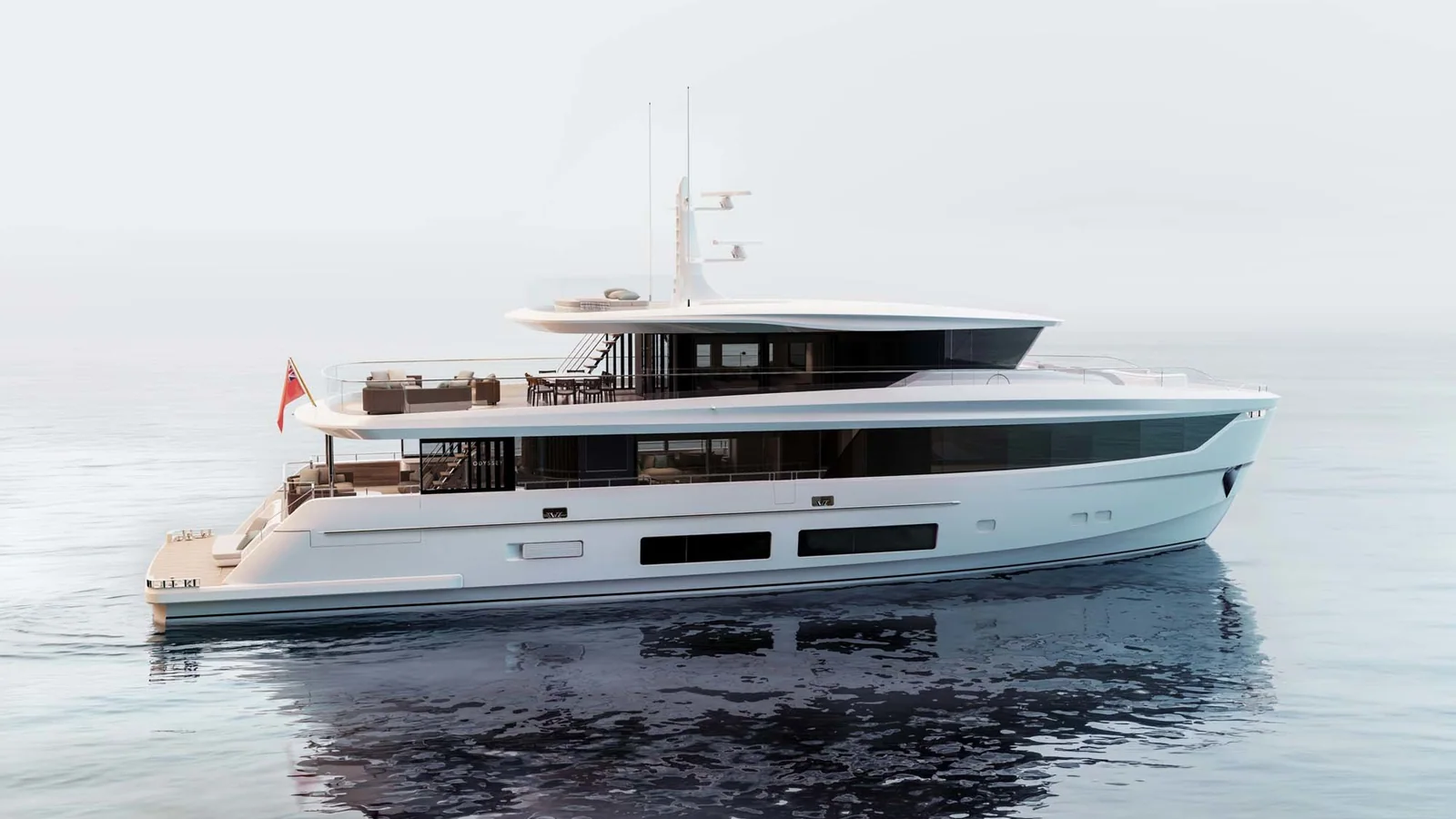
Princess Yachts has released the first exterior and interior images of the Odyssey 108 and presented a scale model at Monaco Yacht Show. The new tri-deck measures 32.9 metres, with a 7.6-metre beam and 1.99-metre draft, moving Princess back into the 30-metre-plus market where buying dynamics are closer to superyacht new-build than standard production ordering.
The key point is not the badge change from yacht to superyacht, but the intended use profile. Princess describes the Odyssey 108 as a passage-making platform, publishing a range of more than 2,600 nautical miles at nine knots, a top speed of up to 21 knots and accommodation for eight to ten guests in four or five cabins.
What Buyers Should Test
The project uses a new Hybrid Fast Displacement Hull developed with Olesinski. Princess says the programme has been through CFD work and the first stage of physical tank testing. That matters, but a buyer should still ask for the operating assumptions behind the headline range: hotel load, fuel reserve, displacement cases and expected noise levels at economical speed.
Interior styling is being developed with Harrison Eidsgaard. Large glazing, a skylounge and tri-deck volume will help the model sell emotionally, but the purchase conversation should focus on configuration. A four-cabin plan supports a more private family yacht; a five-cabin plan increases guest or charter flexibility, although every extra function on a 33-metre yacht competes with technical and service space.
A Long Lead-Time Decision
Princess plans to launch the first Odyssey 108 in 2029 before a world premiere in 2030. That schedule means buyers should treat the project as a long-horizon contract, with careful attention to cost indexation, milestone payments and guaranteed performance.
Our recent note on Monaco technology launches looked at onboard systems. Odyssey 108 shows the other side of the same market: builders known for 15-25 metre yachts are trying to earn credibility in larger platforms. For a W Yachts client, that widens the shortlist, but it also raises the need for tighter technical and contractual supervision before a deposit is paid.