Best Marine Products has published IBEX 2026 material for the Matrix Carbon Fiber Composite Sea Chest, a raw-water intake and distribution module for recreational marine vessels. It sounds like a small machinery-space component. For a buyer of a used yacht, it is exactly the kind of part that can decide service time, pump access and corrosion risk in a cramped technical space.
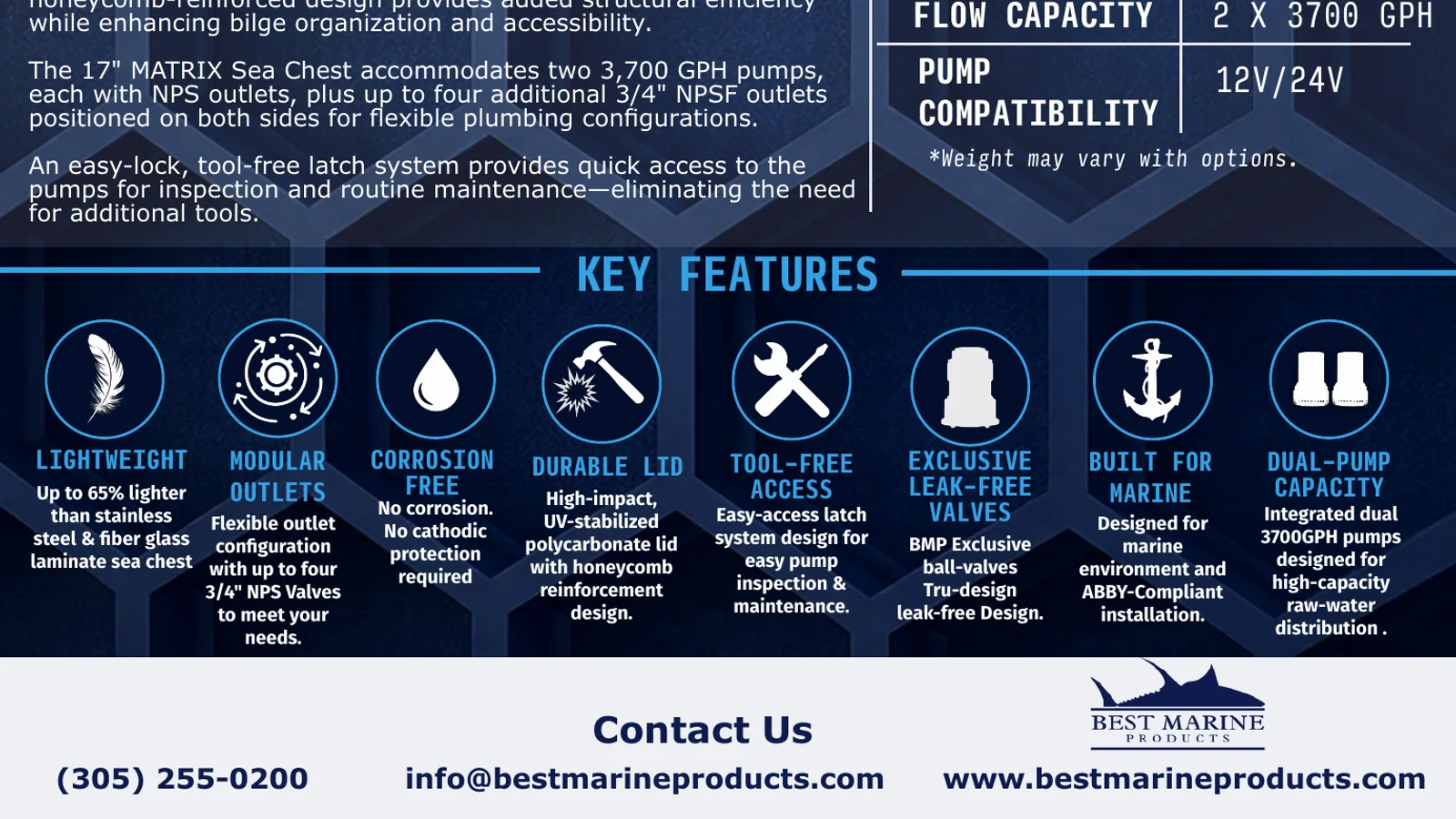
According to the manufacturer’s sheet, the 2-Pump XL version carries two 3,700 GPH pumps, allows up to four additional 3/4-inch NPSF outlets and has a dry weight of 20.6 lb. Best Marine Products describes a glass and carbon-fibre reinforced marine composite body, a honeycomb-reinforced polycarbonate lid, tool-free latching and ABYC-compliant installation.
Why It Matters Beyond The Catalogue
A sea chest is one of those items an owner rarely sees until something fails. Raw water for auxiliary systems passes through it, so flow, pump access, venting, marine-environment resistance and cleaning access all matter. If the module is poorly specified or installed, the consequences arrive later: overheating, pump failures, leaks and improvised plumbing changes.
The composite argument is clear. The company claims weight savings of up to 65 percent versus stainless-steel and fibreglass laminate sea chests, with no cathodic protection required. That should be read technically rather than as a slogan. On a yacht, the material is only one part of the answer. Screw access, mounting, valve quality, installation drawings and space for a mechanic’s hands matter just as much.
What To Check During Survey
A buyer should ask for the raw-water plumbing diagram and identify which onboard systems depend on a single module. It is worth checking whether the installation matches the yard’s drawings, whether valves are clearly labelled, whether the lid gives meaningful pump access and whether routine service can be done without dismantling surrounding machinery-space structure.
This belongs in any serious discussion about when a yacht refit pays off. For a W Yachts client, the broader lesson is to ask about auxiliary systems, not only the engine badge. A yacht often loses time on small technical systems that never get their own glamour shot in the sales brochure.
Sources
- IBEX Show - Carbon Fiber Composite Matrix Sea Chest · 11/10/2026
- IBEX Show - 2026 exhibitor press releases · 11/10/2026