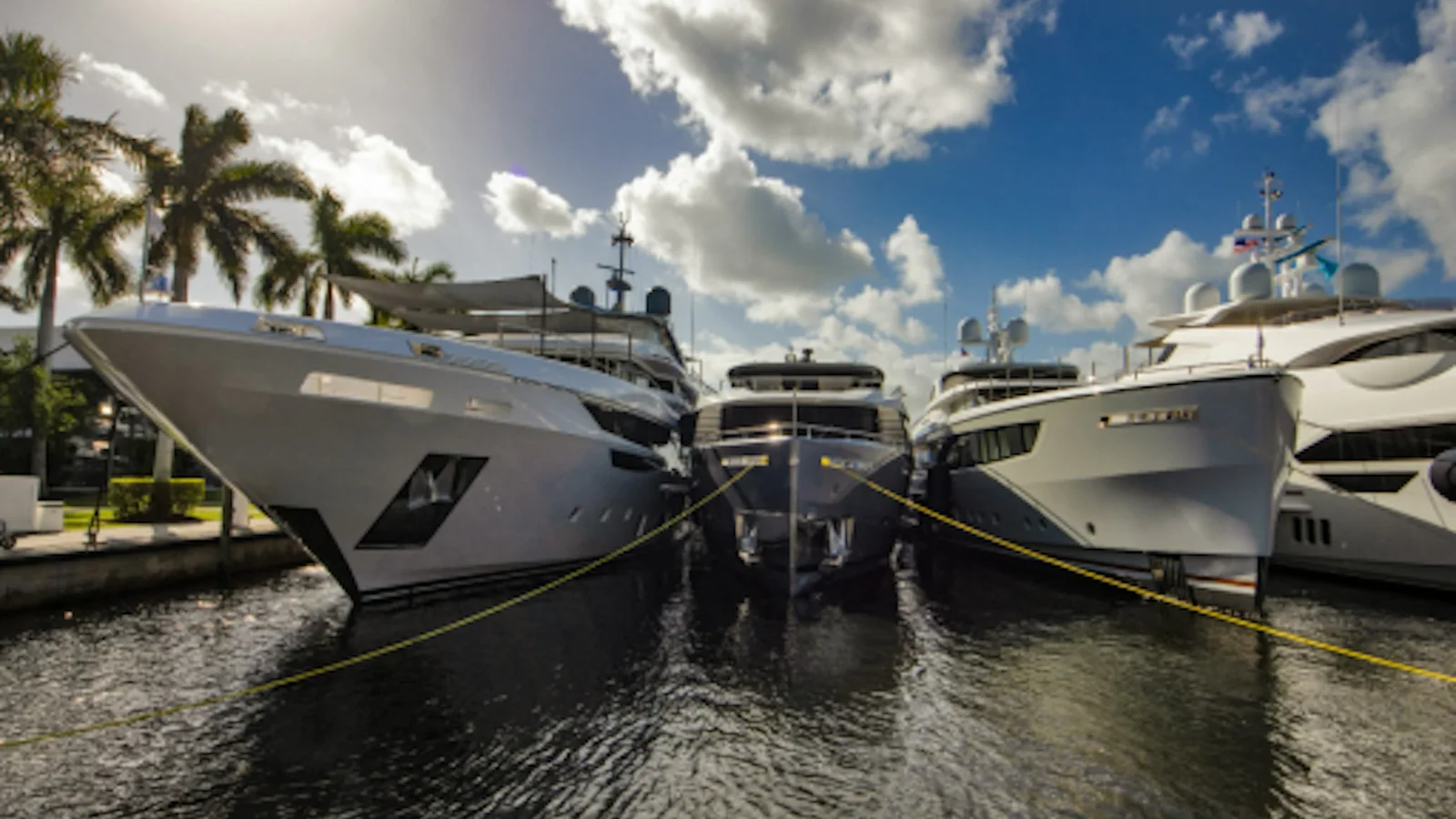
The Fort Lauderdale International Boat Show opens on Wednesday, 28 October and runs through Sunday, 1 November. The organiser is promoting more than 1,300 boats, about 1,000 exhibitors and over 50 debuts. Those figures are impressive, but they will not answer the most important question: is the American market entering a new season with genuine demand, or merely with abundant supply and a crowded show programme?
FLIBS is a useful barometer because several markets meet in one place. New builds, brokerage yachts, production boats, superyachts, technical suppliers and refit yards all converge in Fort Lauderdale. Europe has already shown its hand in Cannes, Monaco and Genoa. It is now the turn of buyers from the United States, the Caribbean and Latin America.
Test One: a large yacht must work beyond the passerelle
The largest vessel announced by the organiser is the 93-metre Oceanco Draak, transformed to support scientific work, diving and a substantial equipment package. She will be joined by the 68-metre Feadship Lady Christine and the 63.7-metre Hakvoort explorer Scout.
Their presence will draw attention, but the market test lies with yachts genuinely offered for sale or charter. A large display fleet has not always produced an equally large number of transactions. In Fort Lauderdale, the useful distinction is whether discussions move towards price and closing terms or remain at the viewing stage.
Test Two: hybrid propulsion moves beyond the headline
The Pearl 100 Hybrid is expected to be one of the show’s principal debuts. It is Pearl Yachts’ first hybrid model and the British yard’s new flagship. Yet the word “hybrid” alone tells a buyer very little. Operating modes, hotel-load balance, noise at anchor, added weight, service access and system-wide warranty responsibility all matter.
FLIBS therefore offers a valuable comparison between new propulsion systems and mature diesel installations. A buyer can examine what is genuinely gained and what carries an additional cost. We explored those questions in our preview of the Pearl 100 Hybrid’s Fort Lauderdale debut.
Test Three: power catamarans enter the mainstream
The Prestige M8 EVO is due to make its US debut after its world premiere in September. The Aquila 35 Sport represents the American debut of a smaller and faster power catamaran. They address different buyers, but point in the same direction: the power catamaran is no longer simply an alternative to a monohull. It is developing distinct segments, from day boats to large family platforms.
Due diligence must go beyond saloon volume. Berth availability, head-sea behaviour, tunnel noise, close-quarters handling and resale demand all deserve attention. European owners must also consider seasonal marina availability. Fort Lauderdale will indicate whether American demand in this segment is still accelerating and how quickly dealers are building the support behind it.
Test Four: buyers want boats they will actually use
The carbon-built Delta 72, Galeon 570 SKY with its concealed flybridge, outboard-powered Princess C48 and new Viking and Valhalla models represent different styles, but all emphasise owner use. That matters at a show where scale can easily be measured only in length.
Between 35 and 75 feet, operating cost reaches the decision more quickly. Buyers ask about berth size, cruise-speed consumption, operation without permanent crew and service lead times. That is why the US debut of the AB 95S with a claimed speed above 53 knots is more than a performance display. It will also test how many buyers accept the cost and complexity of that configuration.
Test Five: refit becomes a market of its own
This year’s FLIBS includes a seminar series previewing the full RefitX format planned for 2027. The programme covers refit budgets and schedules, South Florida yard capacity, infrastructure, skilled labour and the question of why some major projects still travel to Europe.
This is not a side issue. As the fleet ages, technical records, project scope and the yard’s ability to hold a schedule become increasingly important. For an owner, the difference between a controlled refit and an open-ended project can exceed the original purchase-price saving. Our guide to when a yacht refit makes economic sense is equally relevant to the American market.
What FLIBS will actually reveal
The organiser has divided the show across six locations: Broward County Convention Center, Bahia Mar, Hall of Fame Marina, Las Olas Marina, Pier Sixty-Six and Superyacht Village. It is logistically demanding, but that breadth is precisely what gives FLIBS its value. A buyer can compare a production yacht, a power catamaran, a hybrid installation and a brokerage boat on the same day.
We will not judge the show’s success by crowded docks. Contract announcements, the quality of buyer conversations, real delivery dates and the number of debuts progressing to sea trials will matter more. W Yachts will follow FLIBS from a purchasing perspective: model, configuration, support and resale value matter more than a place on the debut list.